
Share Bessie "Vasiliki" Marinos's obituary with others.
Invite friends and family to read the obituary and add memories.
Stay updated
We'll notify you when service details or new memories are added.
You're now following this obituary
We'll email you when there are updates.
Select your format and elements to print

IN LOVING MEMORY OF Bessie "Vasiliki" Marinos
Bessie "Vasiliki"
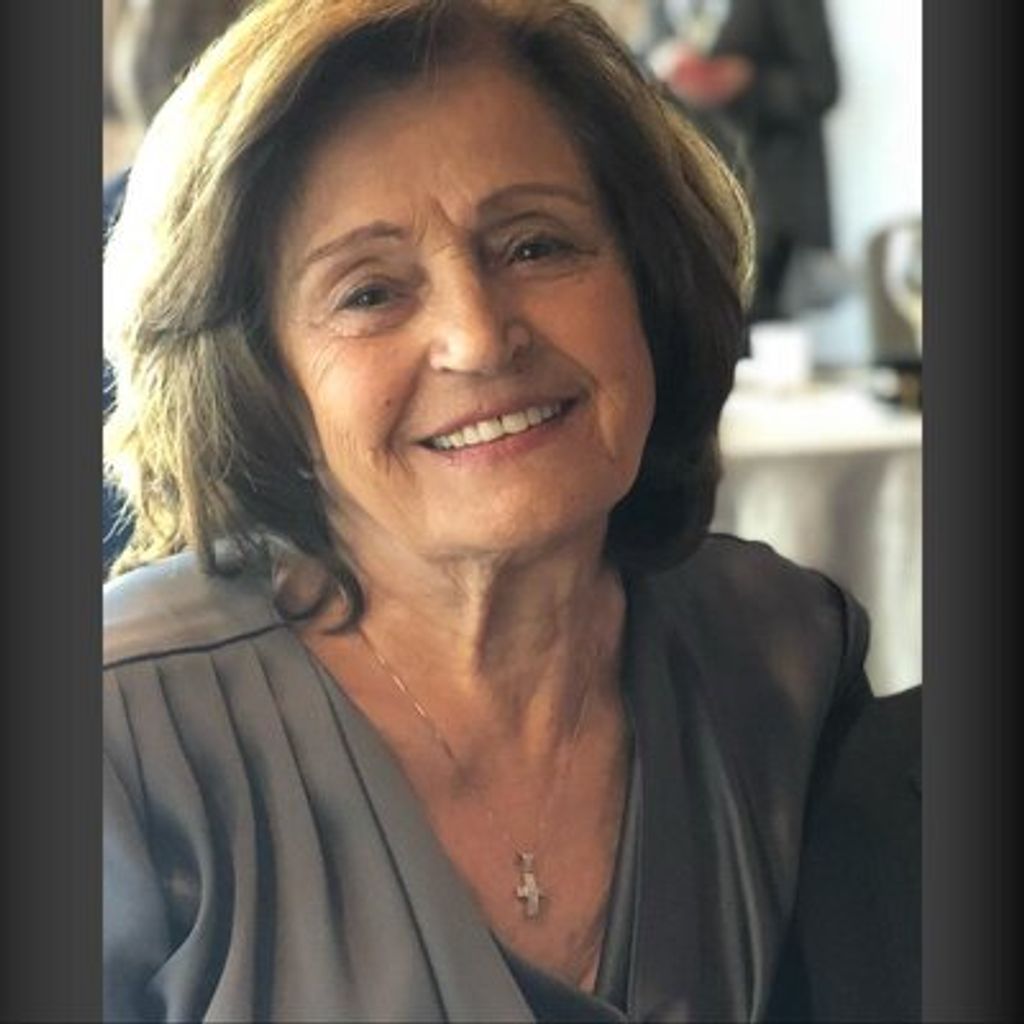
Marinos
October 10, 1938 — January 5, 2022
La Palma
Bessie "Vasiliki" Marinos' Obituary
For some of us life can be an adventure. Unimaginable forces intervene leading to journeys unexpected, and pathways explored that were once beyond one's grasp, but now marked with our own footsteps. Bessie Marinos had such a life. There was trepidation, courage, fear and most importantly in the end, the everlasting embrace of unconditional love she shared with her family and her church.
Vasiliki had always believed she was born on October 10, 1938, in Zevgolatio, Greece. While filing paperwork from the "old country" in 2012, Vasiliki discovered that her birthday was actually October 9, 1938. When asked how one does not know their exact birthday, she explained that name days were more important when she was growing up.
Bessie was the youngest of four children born to George and Eleni (maiden name: Malliris) Gargalionis. Her siblings from oldest to youngest were John (Yiannis), Nicoletta and Pete (Panagiotis).
Bessie was baptized into the Greek Orthodox Church by her Nouno (Godfather) who was Stavros Gikopoulos. Zevgolatio was a small farming village (Horio) outside Tripolis, Greece which is located in the Arcadia Region of Greece within the Peloponnese Peninsula.
Bessie's mother Eleni, had blonde hair and blue eyes. Bessie had told her children that her mother was a smart woman who had more than a lot to say about the family's dealings. Yiayia Eleni was very shrewd. However, Bessie was a Daddy's girl. Even in her later years, Bessie's eyes would light up when she spoke of her Father. He was described as handsome and very caring with a big heart. Because the personalities seemed so different, we inquired how the two of them met and Bessie said that her mother had somehow selected him.
Tripolis is in a mountainous region on a plateau or basin with cold winters and warm summers. Hence, the farming climate was not as forgiving as some of the warmer areas of Greece, so its citizens were strong with a persevering spirit. Bessie was no exception. Girl, boy, woman or man, it made no difference. All members of the family were tasked with fostering the family with the labors of running the farm. They grew potatoes and grains. They also kept chickens, goats, pigs and turkeys for domestic use. The winter could be cold and there was often snow. Regardless of weather, the duties of the farm always carried on.
My mother's family existed simply. Electricity, plumbing, heating and air-conditioning were things they did not know. Bessie would have told you that all those things meant nothing. They, nor their neighbors possessed such things, so the comforts of the modern world were not missed.
Bessie's childhood home was located on the side of a mountain. That meant everything had to be carried in and out. One of the tasks she spoke of frequently was the carrying of buckets of water from the well to the house. Apparently, water had to be carried several times a day and it required muscle. She never complained about her work as a child. Instead, she used it as an example to teach her children that Zoi Echei Kopo (life has toil).
Bessie attended school until the sixth grade. She really enjoyed school and learning. Unfortunately, in those days it was not considered as important that women or girls receive a lengthy education. However, her parents recognized the value of education and did send her brothers to school.
Bessie never resented her brothers for the educational opportunity they received. However, in her later years, Bessie finally did tell her children that she really wanted to attend more school. She explained that it was a deep regret in her life that she was not given the opportunity to further her education. It was one of the few times she expressed wrongdoing on her parents' behalf. It is one of the reasons that education was without question, the most important gift she could give to her children. In fact, bringing home a bad grade in school could possibly result in a reign of terror not unlike shock and awe.
It is important, however, to understand that Bessie was a woman of indomitable spirit, courage, and resilience. Her limited education or the fact she was a woman never made her hesitate or feel afraid to conquer new challenges or try new things. One time she and her husband were negotiating the sale of one of the family's restaurants. The man they were dealing with wanted a lower price. He turned to Bessie and said, "Bessie you can't let your husband keep working like this. It is going to kill him." At that time, her husband Dean was working 14-15 hours a day, every day with no days off. Being a man, the buyer thought he would appeal to Bessie to gain leverage. After all it was the late 1970s, and she was a woman. Perhaps she would be weaker and more lenient. Bessie turned to him and stared him down and said, "My husband has life insurance. If he dies working, its fine. Either way, his children and his wife will be taken care of." My parents got the price they wanted for the business.
As a child, food for Bessie was simple. It consisted of tarhana and hilopites. These are pasta like substances are made with milk and eggs and the ingredients were readily available. Prepared correctly, they would make delicious meals that are filling. Meat for the most part, was a treat and would only be consumed on great celebrations like Christmas, Easter or Panagia's. Bessie's children recall that while growing up their mother never had to use imagery incentives involving starving children in Africa to get them to eat. Instead, she would say, "I know what it is like to go to bed hungry. I can make that a happen for you…. now eat." Usually, she would follow up with something involving God and his giving nature as well. Either way it was a difficult logic to argue, so the children would eat.
Until about the time Bessie was nine years old, she was living in a wartime environment. Greece was invaded by Germany in 1941 and then was involved in a horrible civil war until 1949.
This wartime environment coupled with an already strong Greek tradition of tightly knit family units, is how was Bessie's attitude towards family was formed. She was extremely loyal to her family and strove endlessly forward with the message of unity, love and loyalty amongst family.
Bessie would tell her children, "You must always protect each other. Never let anyone put your family down." She would tell a story about her brothers to her children that would clarify this ideal of family. Once, her eldest sibling Yianni, who by all accounts was a big-hearted kind man, was in a Kafenio. Bessie's other brother Panagiotis was sent by his parents to fetch his brother who was needed at home. Panagiotis was a jovial man, but he was not a man that suffered fools. He was quick tempered and enjoyed any opportunity to rumble. That day Panagiotis walked into the Kafenio and saw his brother Yianni with a sign taped to his back which read "Gaidaros pouliete" (Donkey For Sale). It was zero to one hundred – Vesuvius exploded. Panagiotis grabbed a chair and laid down a fabled beating of every man present. Legend has it that those closest to the door were fortunate. Needless to say, Bessie did not have two stories to tell about family loyalty. No one in the village was crazy enough to test the familial bonds of the Gargalionis family again.
You can imagine, with this kind of steadfast belief in the value of family, there were never prolonged fights or longstanding resentment in Bessie's home. Her children will forever remember her words "Thelo panta na esaste agapimene" (I want you to always care for each other).
With older brothers and a shrewd wife helming the household, Bessie's father, George, left to pursue a better means in America around 1950. He had two brothers working in the United States and after years of war, the economics of the country had been shattered. It seemed prudent to take a journey in order to pursue the promise of America.
These were difficult years for Bessie. It was not like you could pick up a phone and make a Facetime call. There were no phones. Although her mother loved her, she did miss her father's kind and loving demeanor. Bessie did say that it was at this time she became an expert in avoiding any physical discipline from her mother. Bessie was quite the athlete and could run, jump, climb or do whatever necessary to make sure the "old lady could not catch her." I guess all the hours of carrying water to the house had some unforeseen benefits.
Eventually her father returned from the United States. He did not find the fortunes that many other Greeks had. He did, however, prosper enough to help his family ascend from post war.
In 1961, the path that Bessie walked took a dramatic turn. Brooklees (a term associated with Greek males returning from America to visit their country of origin), began returning to Greece, many of whom, were looking for a bride.
In those days in Greece, daughters were not given a blessing to marry if they had an older sister who was still unwed. Of course, if one asks younger sisters of that era, many of them might infer that they were the fairest of them all and hence, potential suitors had to observe proper decorum, which meant they would have to wait. Bessie might have mentioned (bragged) to her children that she was a real looker and considered very beautiful. The line of anticipatory suitors was distinguished and lengthy.
Two months after Bessie's older sister Nicoletta was married, a Brooklee visiting from California saw her on the street. His name was Dean Marinos. He later told his children that she was the most beautiful woman he had ever seen. (Smart description) Bessie was everything he had been looking for – A younger beautiful Greek girl from a good family. Inquiries were made. He wasted no time. In fact, he wasted no money. Instead, clever and expedient, Dean, as customary in those days, bypassed all these courtship rituals and approached Vasiliki's parents. He spoke frankly with them explaining that he was a wealthy American (he may have stretched the truth a little bit) and his intention was to take their daughter's hand in marriage. Vasiliki's parents arranged a meeting in a public place under the watchful eyes of the family.
Bessie explained that Dean was nice and well mannered, but the conversation was not flowered with Shakespearean wooing prose. It was very honest and frank. She said that Dean explained, "Vasiliki (Bessie), I want you to understand I am planning on returning to Greece to live. I want my family to be Americans. It might be a long time before you see your family again."
After meeting with Dean, Bessie returned home and conversed with her parents. They inquired as to her opinion of Dean. Bessie explained that she thought he seemed nice, but, and more importantly, Bessie asked how they felt. Bessie explained later to her children that the times were very different. It was the duty of a daughter to respect her parents' wishes. Hence, although they may have asked how she felt, the truth was that it was the parents who would decide whom she would marry. They told her that they thought he was a good man and that she would marry and go to America. Her parents felt that she was wise and resilient. She would do well in the United States.
Bessie was obedient and followed the path carved out for her by her parents. Two weeks later, on January 22, 1962, Dean and Bessie were married in the church of Agia Triada, in the village of Zevgolatio.
Bessie told her children; she was apprehensive about the path her life was about to take. She was 21 years old and had never left the Tripoli region. She was to be joined in matrimony to someone she did not know, and travel to an unfamiliar land without speaking the language. She was going to be removed and far from the thing she faithfully believed in and knew – her family.
Bessie's children commented that their parents really would have initially preferred they marry other similar Greek American people. The families would have a core understanding of each other. However, Bessie's children agree that although Bessie and Dean grew to find an everlasting love, the experience of allowing parents to meddle in matters of the heart resulted in Bessie being careful not to be intrusive when it came to such matters. Hence, Bessie and Dean were careful not to be demanding when it came to their children and their chosen spouses. In fact, when considering marriage, she would always tell her children "I am not going to tell you what to do. Make your own decision. I don't want you to turn and blame me someday if things don't work out."
In Greece, in those days it was customary for the family of the bride to provide a dowry (prika) to the groom. Bessie's dowry was not much, but Dean said she was the prize.
The children recall one lively competitive discussion Dean and Bessie were having about family and whose was better. Bessie's family, the Gargalionis or Dean's, the Marinos family. This type of competitive bickering was always entertaining. However, Dean made a fatal mistake this particular evening and said, "Bessie your family's Prika (dowry) was one goat, a chicken and a klitza handed down three generations." That resulted in the immediate end of the discussion…. the silent treatment followed by two dozen red roses. It was never a good idea to take sides against Bessie's family.
It took approximately three months for Bessie to be approved access to the United States.
They boarded a boat and sailed across the Atlantic. Upon arrival, the name Vasiliki was changed to something easier for the English language speakers. She officially became Bessie.
Dean and Bessie returned to the United States in April of 1962. Initially, they shared a two-bedroom apartment with Dean's brother Mikas. Bessie recalls this as one of the most difficult times in her life. Her husband would leave for work early in the morning and return late in the evening. She did not know how to operate an automobile or speak the English language. Because her family in Greece did not have a phone, she was not able to reach out to hear a familiar voice. She was extremely lonely. She describes crying alone for hours on end. Her mind consumed with questions. Why did my parents send me here?
Then came something positive, In February of 1963, Dean and Bessie purchased their first home together. It was 3334 33rd Street in the North Park area of San Diego. The timing of the new home was perfect. Soon, more living space would be required. On April 15, their eldest daughter Sofia Marinos was born.
Bessie explained that the home she purchased was in an area in which many other Greek immigrants had purchased as well. This created a dramatic change in her life because now she had friends. A community. A new Horio (village). Maria Kladouras, Voula Parashos and later, her sister-in-law Sotiria would all come together to help each other. One would get a Driver's License and in time teach the other ladies. Sotiria would say that many times they shared cooking responsibilities. One person would cook and everyone would feed their children. It was a true sisterhood. They taught each other how to read. They helped each other with babysitting. It was a happy time. A time when there were no great riches, but deep lifetime friendships were formed. These women from the old country coming together in support of each other, all the while unknowingly transforming themselves into wise and worldly American women.
As Bessie changed and grew, so did her family. On September 1st, her second daughter, Eleni Marinos was born.
Not to dismiss the accomplishments of women of today, but Bessie would tell you that in those days men were absolutely no help around the home. Women did it all…diapers, laundry, shopping, sewing, cooking and self-beautification of course. In later life, she chuckled at the notion of men getting paid family leave. She would ask "Is that so they can breast feed?"
Although two girls were an unbelievable blessing, Dean and Bessie really both wanted a son. In later years, Bessie told her son that God had always been good to her. She prayed for a son, and he blessed her with one. On October 20, 1968, their third child was born. The tradition amongst Greeks is to name the first male child and female child after the paternal parents. In this case, Bessie persuaded Dean to name the child after her father and so it was. Their son was named George. Being a masculine child and the youngest in a Greek family in 1968 was as close to Nirvana as one could achieve within the confines of earth. When Bessie had given birth to Sofia and Eleni, Dean gave her flowers. When she gave birth to George, the gifts (plural) consisted of a gold and diamond watch with a trip to Greece to ensure he was baptized in the church outside of Dean's village. It was a cruel twist of fate for the two girls, but at least they were allowed to continue their education beyond the 6th grade.
As much as Bessie cherished her friendships in San Diego, she wished for something more. She wanted to build something more substantial. She wanted to make sure that she could help her children as they matured. There were large potential expenses on the horizon like college or the purchase of a first home. Her husband Dean worked like a maniac, but it was just not producing results.
Then the screws started to turn. Bessie explained that she had many conversations trying to convince her husband Dean to roll the dice and move to Los Angeles. His brother Mikas and his wife Sotiria moved to Los Angeles and were doing well. Dean was trepidatious about such a move. His cousins and friends were all in San Diego. As the days past the screws tightened. Finally, exasperated Dean said, "Women, (I did say exasperated) why are you going on about moving. You have a roof above your head and food on the table." Bessie paused for a moment and said, "I could have had that in Greece and stayed close to my family. You brought me here with the promise of something better." There was a pause, then Bessie continued "Look - Dean you are better than this. You are more talented than this! I promise I will help you. You can do this!" Adults to children, everyone finds comfort and courage from support. It was a specialty of Bessie's. She could lift you up and make you believe.
In 1974, they sold the Trocadero restaurant in San Diego, rented out their house, packed the kids and belongings and moved to Downey. With a little financial help from Dean's brother Mikas and his wife Sotiria, they purchased a DENNY'S franchise.
True to her word, Bessie was no longer a homemaker. Literally overnight, she became the floor manager of the restaurant. They were a formidable team. Dean handled all the back of the house responsibilities and Bessie managed the floor. The restaurant was open 24 hours a day. If the graveyard manager called in sick, then Bessie would fill in. One night while working graveyard, four gentlemen had stumbled in after a night out cocktailing. As they sat, they began to argue. They stood up and before the argument escalated into an all-out fight, Bessie stepped in and said, "Wait! If you are going to fight, get out of the restaurant." They proceeded to go out into the parking lot and beat each other senseless. It was a carnival of carnage. About five minutes later Bessie walked outside. The combatants were bloodied gasping for breath. Bessie looked at them, shook her head and said "Are you done now? Why don't you come inside get something to eat." They agreed. Bloodied and beaten they ordered a round of steak and eggs - happy and content they later departed.
In 1976, Dean and Bessie sold the Denny's, and they bought Huffs. The formula they created in the Denny's worked. Dean would handle the back of the house and Bessie "The General" would take care of the front of the house.
Together they were in rhythm like a well-orchestrated song. Different notes played in unison and made beautiful music. At Huffs, all the promise of America finally was visited upon them. They delivered on paid college educations for the children and provided assistance to ensure they had a solid foundation to start their adult lives.
Initially, they purchased a home in Cypress and eventually purchased their forever home in La Palma, Ca. It was in this home tables were prepared for the future in-laws of Dean and Bessie. It was in this home seven grandchildren were spoiled.
Bessie was the glue that kept the family strong. When Dean was at work, and he was always at work, Bessie would explain to the children, "Daddy is working hard for you – so you can have a better life. He would love to come spend time though." The children never resented their farther or harbored feelings that he cared about work more than them. Whenever any challenges presented themselves to her family, it was her voice that would pick them up. "You can do it. Nobody is better than you.'
Her commitment to family was unequivocal. She taught her children to protect each other and to care for each other. If there was a bully on the block, then they would deal with the oldest Sofia. If support was needed, then the other siblings were there to give. This is what she taught and what her children grew to know.
She raised her children to be courageous. She helped them find solid footing in times of doubt. She almost never spoke of the time she struggled when she first arrived in America, because she did not want it to become a predominant theme of life. Her brother Panagiotis' tough spirit resided in her as well. One time her son George came home from school crying and Bessie said, "Why you crying?" George explained that he got punched at school. Bessie got angry and slapped George a couple of times and said, "Men do not cry from fighting. Never hit anyone, but if someone hits you then you rain down punches on them. Do you understand?" The next day George was signed up for karate.
Bessie never could quite grasp modern parenting. Bessie did some spanking in her younger days. It is rumored that she had the fastest wooden koutali (spoon) in the west. She could also crack a bullseye with a pantofla (slipper) from about 15 yards out. For the sake of small children who might be listening, we do not want to discuss the Louda (a long skinny switch). Either way and by whatever means, if there was a transgression you received a spanking. Then, as quickly as it came, it was let go and forgiven. She did not harbor the anger, but instead was back to a caring and loving mother. She would tell her children that the "time out" rule they applied to her grandchildren was ineffective. Why not just a quick smack with explanation and then move on? I think her children will forever wonder about the merits of the old school approach.
Whenever her children were injured or required hospitalization Bessie was present. Morning to night, day after day. She would never leave their sides. Always faithful, always concerned until their strength returned.
She was never really able to continue with the vigor of life she had known after the loss of her eternal partner Dean in November of 2019. He was her once in a lifetime love. They met strangers, but grew together and eventually entangling one another.
When her health started to fail, Bessie showed strength and fought valiantly. She provided example to her children and grandchildren of grace under pressure. When the medical factors proved overwhelming, she turned to her children with a clear mind and steady voice and said, "I love you, but it is time to go see Dean." She led the way and spared her children the difficult end of life decisions. She alone took the turn on the path to light.
We will miss her old-school wisdoms.
All her children will miss her and the idea of the forever home she represented. A connection to the past is now only carried in their hearts and memories. They have now graduated becoming adults in a world void of the forever outstretched arms of their mother and father. They now conduct their life as trapeze specialists without a safety net below. They will carry her memory eternally. They will hear her voice in their mind and continue to honor her and promise to be Agapapimene.
We love you, from Sofia, Eleni, George, Jim, Bjorn, Dayna, Elizabeth, Dean, Stefan, Alex, Aristos, Devyn, Konstantinos, Mikas, Sotiria, Tim, Elaine, Sofia, Aristos, Aristos and all the extended Marinos Family.
Both services will be held at Saint John the Baptist Greek Orthodox Church, 405 N. Dale Avenue, Anaheim, CA. Trisagion at 6:00 PM on Monday, January 10, 2022. Funeral at 11:00 AM on Tuesday, January 11, 2022, followed by the Makaria.
Arrangements under the direction of Chapman Funeral Homes - Terry & Mary Harmon, Funeral Directors. Toll free (855) 628-0447.
______________________________
Obituary notice for Chapman Funeral Homes. Please visit
www.chapmanfuneraldirectors.com
.
AmericanObituary.com
is a Baywalk Marketing service.
facebook.com/AmericanObituary
-
twitter.com/AmericaObituary
Funeral Services for Bessie "Vasiliki" Marinos
Trisagion

Monday
Saint John Greek Orthodox Church
Starts at 6:00 pm
Funeral Service
Tuesday
Saint John Greek Orthodox Church
Starts at 11:00 am
Bessie "Vasiliki" Marinos' Guestbook
This site is protected by reCAPTCHA and the
Google Privacy Policy and Terms of Service apply.
Service map data © OpenStreetMap contributors